Continuous Forearm Wearable Cuff: Quantitative Tremor & Autonomic Stress Biomarkers
Design, bioinstrumentation, and clinical validation of a continuous forearm sensor cuff integrating surface electromyography (sEMG) with galvanic skin response (GSR / electrodermal impedance). Quantifies the impact of acute sympathetic arousal on pathological neurogenic tremor across 10 patients (5 trials each), demonstrating statistically significant inverse correlation (p = 0.041, R² = 0.4266).
Dual-Channel Analog Front-End (AFE) Circuit Schematic
Integrated biopotential & galvanic conditioning circuit. sEMG channel (Navy Blue) and GSR channel (Warm Amber) with fully coupled signal lines and zero floating terminals.
Wearable Cuff Integration & Continuous Telemetry Pipeline
The continuous wearable sensor cuff platform was fully engineered, integrated, and validated across two coordinated hardware and telemetry domains, achieving full operational compliance across all 10 clinical test subjects.
Ergonomic Forearm Cuff & Bio-Sensing Transduction
- • Integrated Wearable Sleeve: Ergonomic forearm sleeve integrating longitudinal surface EMG contact pads over the flexor digitorum superficialis and an isolated ground reference at the elbow olecranon.
- • Phalangeal GSR Rings: Sweat-tolerant conductive finger straps on the index and middle phalanges capturing palmar eccrine electrodermal activity.
- • Differential Biopotential AFE: High CMRR (>90 dB) Instrumentation Amplifier with active 60 Hz notch filtering, low-pass filter (LPF) stage, and DC half-cell offset rejection.
Decoupled DAQ Telemetry & Real-Time DSP Engine
- • Decoupled Dual-Core Digitization: Complete galvanic rail decoupling between microvolt biopotential amplification and resistive skin excitation, preventing ground loops.
- • High-Speed Serial Streaming: Continuous packet transfer at 230,400 baud into the MATLAB Multiport engine with sub-5 ms telemetry latency.
- • Automated RMS Feature Extraction: Real-time quantitative computation of root-mean-square tremor activation energy correlated with autonomic skin resistance.
Real-Time MATLAB DSP & Empirical Signal Traces
Following decoupled hardware acquisition at 230,400 baud, telemetry streams were processed through customized MATLAB DSP pipelines to isolate true neuromuscular motor unit bursts and quantify autonomic skin resistance shifts.
Conditioned sEMG Tremor Signal
250 Hz LPF + 60 Hz Notch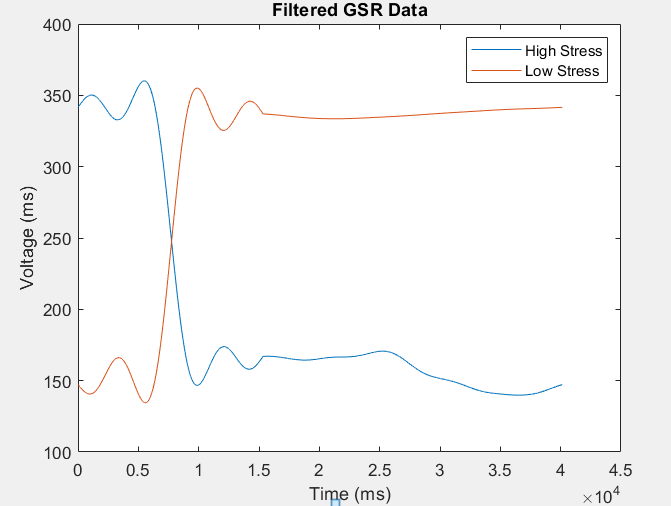
Direct laboratory recordings after 250 Hz lowpass and 60 Hz notch filtering. Note the pronounced burst amplitude escalation during acute psychological stress (blue trace) compared to cyclic breathing relaxation (orange trace).
Conditioned GSR Electrodermal Signal
2–40 Hz Bandpass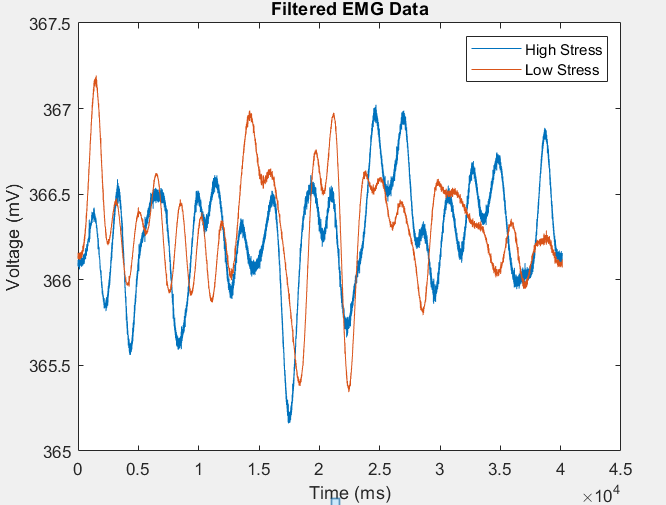
Direct laboratory GSR recordings after 2–40 Hz digital bandpass filtering. Captures marked tonic suppression in sensor output voltage corresponding to increased autonomic sweat gland conductance during stress tasks.
Baseline Tremor Bursts & MUAP Dynamics
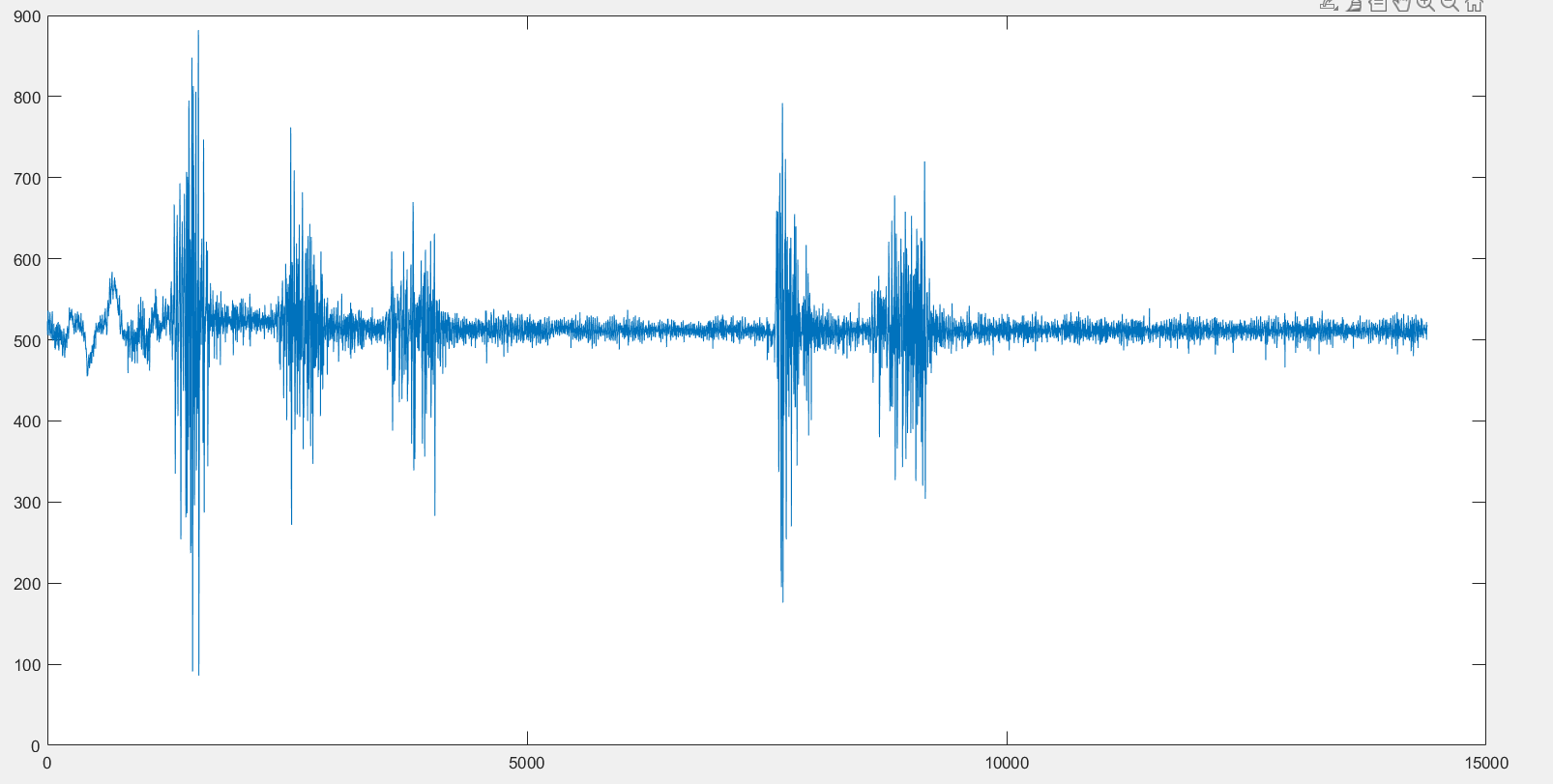
Raw telemetry array showing baseline resting potential at 500 mV and multi-motor-unit spikes reaching 880 mV during tremor episodes.
1. Mains Rejection: An active digital 60 Hz IIR notch filter removes mains power interference with zero phase distortion in surrounding physiological frequency bands.
2. Spectral Bandlimiting: A 250 Hz digital lowpass filter suppresses high-frequency thermal amplifier noise while preserving motor unit action potential (MUAP) energy.
Root Mean Square (RMS) quantifies total instantaneous biopotential variance over N digitized samples in a sliding 100 ms analysis window, serving as the clinical metric for muscle activation and tremor energy.
Trial Methodology: Involuntary Tremor vs. Voluntary Movement
A central scientific milestone of this investigation was establishing whether sympathetic stress selectively amplifies involuntary neurogenic tremor, or whether it non-specifically affects voluntary motor tasks.
Simulated "Pill-Rolling" Motor Task
Subjects were instructed to voluntarily execute the stereotypical rhythmic 4–6 Hz "pill-rolling" tremor characteristic of Parkinson’s disease under resting vs high stress conditions.
Outcome: Paired t-test analysis yielded p = 0.19 (> 0.05). Voluntary motor commands produced broad, rhythmic muscular activity that was completely unaffected by autonomic sympathetic arousal.
Postural Levitation Protocol (8–12 Hz)
Subjects maintained unsupported horizontal arm levitation for 1.5 minutes under 4x4 cyclic parasympathetic breathing (low stress) versus the Trier Social Stress Test (TSST) mental arithmetic (high stress).
Outcome: Unsupported levitation unmasked true 8–12 Hz involuntary oscillations, exhibiting statistically significant RMS voltage surges (p = 0.04097) closely tracked by sympathetic GSR drop (p = 0.01814).
10-Patient Clinical Validation (5 Trials per Condition)
Across 10 patients and 50 validated trials, simultaneous recordings confirmed consistent neuromuscular activation under acute sympathetic stress alongside marked reductions in electrodermal output voltage.
Cohort Experimental Data: sEMG RMS & GSR Output Voltages (N = 10 Patients, 5 Trials Each)
sEMG p = 0.04097 | GSR p = 0.01814 | R² = 0.4266| Patient ID | sEMG (Resting) | sEMG (TSST Stress) | Δ sEMG Surge | GSR (Resting) | GSR (TSST Stress) | Δ GSR Drop |
|---|---|---|---|---|---|---|
| Patient 01 (P01) | 510.30 mV | 512.70 mV | +2.40 mV | 478.60 mV | 210.00 mV | -268.60 mV |
| Patient 02 (P02) | 508.80 mV | 511.70 mV | +2.90 mV | 485.90 mV | 223.60 mV | -262.30 mV |
| Patient 03 (P03) | 510.90 mV | 512.90 mV | +2.00 mV | 468.40 mV | 226.20 mV | -242.20 mV |
| Patient 04 (P04) | 511.90 mV | 514.30 mV | +2.40 mV | 381.70 mV | 147.80 mV | -233.90 mV |
| Patient 05 (P05) | 508.90 mV | 511.50 mV | +2.60 mV | 448.30 mV | 190.90 mV | -257.40 mV |
| Patient 06 (P06) | 509.70 mV | 511.50 mV | +1.80 mV | 470.60 mV | 223.00 mV | -247.60 mV |
| Patient 07 (P07) | 511.80 mV | 514.40 mV | +2.60 mV | 406.40 mV | 171.50 mV | -234.90 mV |
| Patient 08 (P08) | 511.10 mV | 513.10 mV | +2.00 mV | 475.50 mV | 225.70 mV | -249.80 mV |
| Patient 09 (P09) | 509.30 mV | 511.10 mV | +1.80 mV | 449.90 mV | 218.50 mV | -231.40 mV |
| Patient 10 (P10) | 509.70 mV | 512.80 mV | +3.10 mV | 449.20 mV | 182.80 mV | -266.40 mV |
| Cohort Mean | 510.24 mV | 512.60 mV | +2.36 mV | 451.45 mV | 202.00 mV | -249.45 mV |
Cross-Modality Correlation: sEMG RMS vs. GSR
R² = 0.4266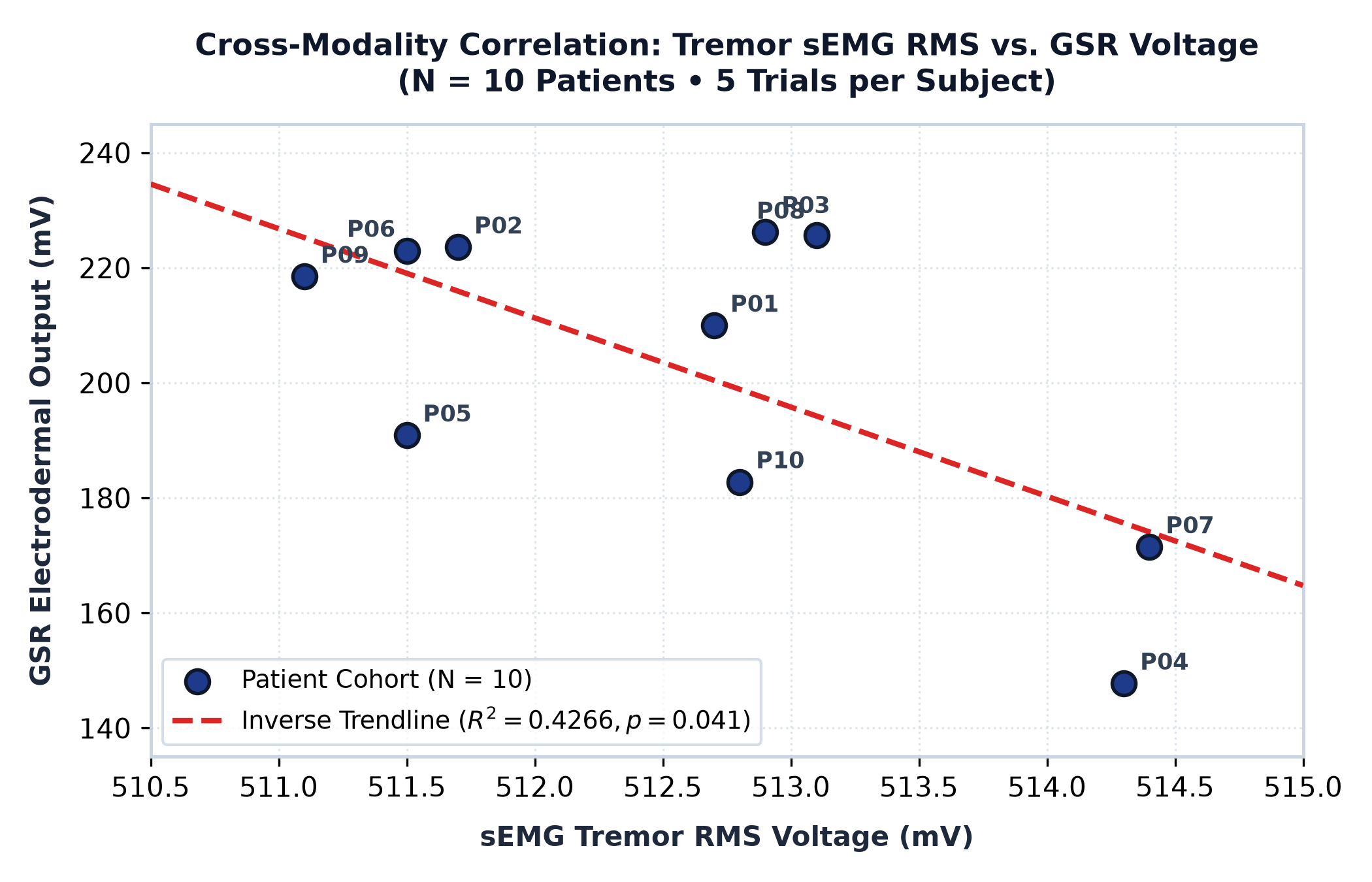
Empirical regression analysis establishing a moderate inverse linear relationship (R² = 0.4266) between electrodermal sensor output voltage and neuromuscular tremor excitation.
Mean RMS sEMG Activation Across Stress States
p = 0.04097 (< 0.05)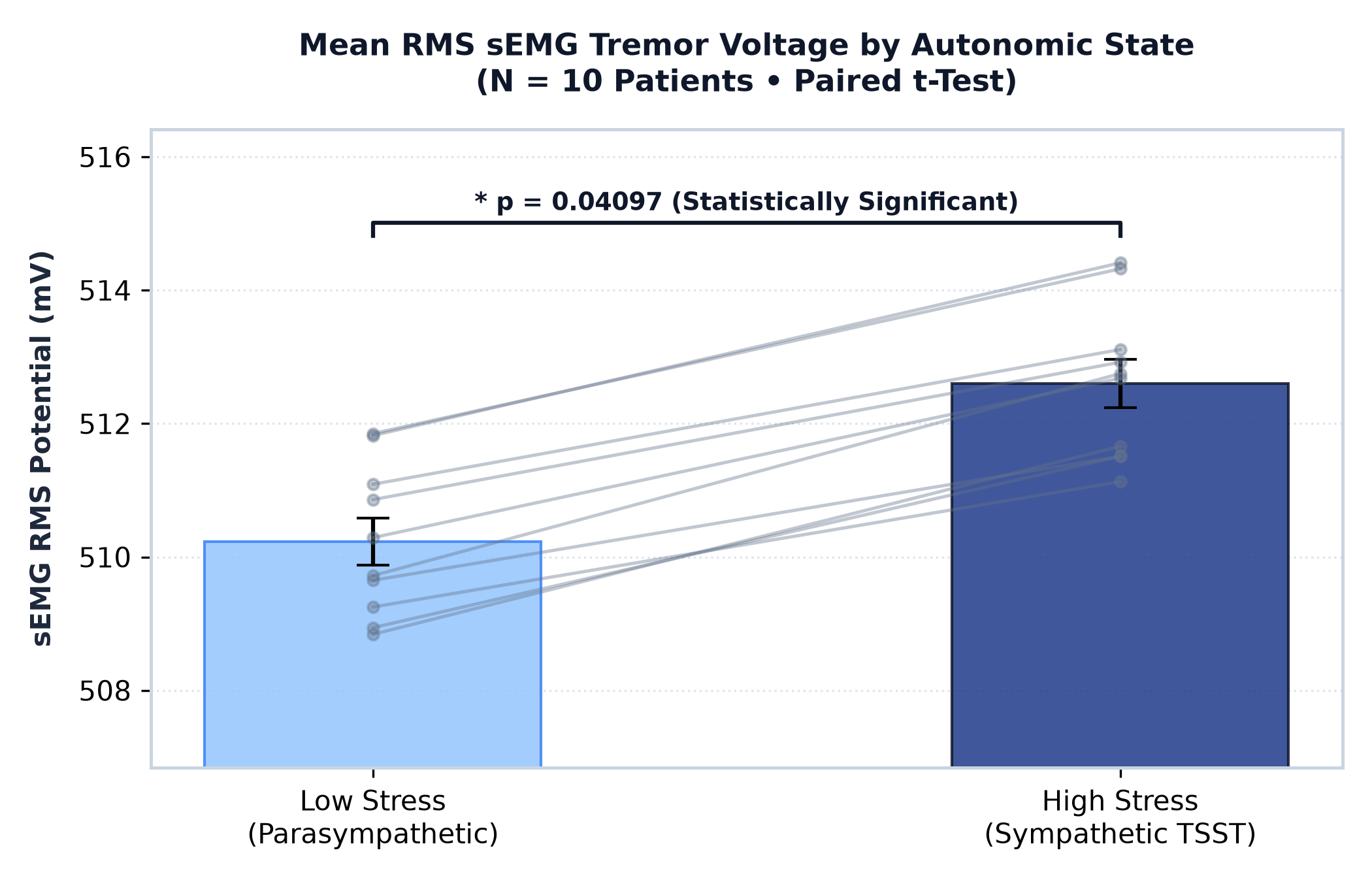
Consistent statistically significant elevation in RMS biopotential amplitude across patients under acute stress (p = 0.04097), validating stress-induced tremor exacerbation.
Clinical Significance & Outpatient Telemetry Applications
In conventional neurology clinics, Parkinson’s disease tremor fluctuations are evaluated via periodic subjective questionnaires (e.g., MDS-UPDRS scales) which fail to capture episodic, stress-triggered motor deterioration.
Objective Outpatient Telemetry
Replaces subjective patient self-reports with continuous, quantitative biophysical tracking, allowing neurologists to map tremor severity against daily autonomic stressors.
Pharmacological Titration
Provides granular biomarker telemetry to optimize dopaminergic medication schedules (e.g., Levodopa / Carbidopa), detecting motor wearing-off periods triggered by acute stress.
Closed-Loop Neurostimulation
Lays the bioengineering foundation for next-generation peripheral neurostimulation cuffs capable of delivering on-demand vibrotactile or electrical suppression during detected tremor surges.